Showing posts with label Black cobra snake. Show all posts

Monday, September 26, 2011

Black cobra snakes

king cobra (Ophiophagus hannah) is the world's longest venomous snake, with a length up to 5.6 m (18.5 ft).[1] This species, which preys chiefly on other snakes, is found predominantly in forests from India through Southeast Asia to the Philippines and Indonesia. The heaviest wild specimen was caught at Royal Island Club in Singapore in 1951 which weighed 12 kilograms (26 lb) and measured 4.8 meters (16 ft), though an even heavier captive specimen was kept at New York Zoological Park and was measured as 12.7 kilograms (28 lb) at 4.4 meters (14 ft) long in 1972. The length and mass of the snakes highly depend on their localities and some other factors. cobra's genus name, Ophiophagus, means "snake-eater", and its diet consists primarily of other snakes, including ratsnakes, small pythons and even other venomous snakes (smaller members of its own species, true cobras (of the genus naja), and even the much more venomous members of the krait family). When food is scarce, they may also feed on other small vertebrates, such as lizards, birds, and rodents. In some cases, the cobra may "constrict" its prey, such as birds and larger rodents, using its muscular body, though this is uncommon. After a large meal, the snake may live for many months without another one because of its slow metabolic rate. Toxic constituents are mainly proteins and polypeptides.

During a bite, venom is forced through the snake's 1.25 to 1.5 centimeters (0.49 to 0.59 in) fangs into the wound, and the toxins begin to attack the victim's central nervous system. Symptoms may include severe pain, blurred vision, vertigo, drowsiness, and paralysis. Envenomation progresses to cardiovascular collapse, and the victim falls into a coma.

king cobra is unusual among snakes in that the female king cobra is a very dedicated parent. She makes a nest for her eggs, scraping up leaves and other debris into a mound in which to deposit them, and remains in the nest until the young hatch.

A female usually deposits 20 to 40 eggs into the mound, which acts as an incubator. She stays with the eggs and guards the mound tenaciously, rearing up into a threat display if any large animal gets too close,[32] for roughly 60 to 90 days.

Inside the mound the eggs are incubated at a steady 28 °C (82 °F). When the eggs start to hatch, instinct causes the female to leave the nest and find prey to eat so she does not eat her young.

Black cobra snakes
Black cobra snakes
Black cobra snakes
Black cobra snakes
Black cobra snakes
Black cobra snakes
Black cobra snakes
Black cobra snakes

Saturday, August 27, 2011

Black cobra snake pics and wallpapers

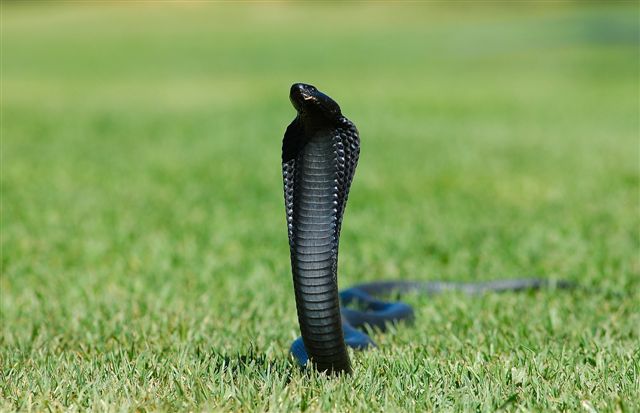
It may enter human dwellings when hunting. It restlessly moves from place to place in search of prey, which mainly consists of mice, rats, poultry, frogs and snakes. Normaly, it is not considered aggressive, particularly shy of human beings and will avoid confrontation. Habitually it avoids confrontation with man, at a chance en-counter, first priority is to escape undetected. On sensing danger it lifts anterior part of its body to have a good look at its surroundings. If not provoked, it lets fall it's body and slips quietly away. However, if provoked, it hisses loudly and sways its hood to advertise its presence, and displays the hood markings to impress its adversary. It fixes its eyes to the source or annoyance, keenly following its movements. However, all the time at the lookout to have a chance to avoid conrontation and slip away. The swaying of hood with dorsal spectacle mark and ventral yellow ocellus, coupled with loud hiss, arc measures to just look as fearsome and as big as possible, to impress the enemy. Cobra attacks viciously and furiously, striking with full strength and biting savagely, chewing the bitten pan. When bitting, it hold on and chews savagely. May strike repeatedly. Pairings are known to be for life, breeding activity is observed from April to July, 12 to 30 eggs are laid in rat holes or crevices, female stays close until hatching.

Cobra frequents different habitats: grasslands, vegetation along tilled fields, along water courses, semidesert forests, barns, ruins with grassy growths and around villages. It is plentiful in paddy growing areas, where it is attracted bv mice and poultry into living houses. It climbs into the branches of trees in search of nesting birds. Often it become resident in rat holes after consuming its occupant.

N.n.naja is found in eastern Pakistan as far west as Karachi. It has been reported from sea level to 4000m in the Himalayas. It may be found in flat grasslands, among scattered trees, near rice fields and other cultivated areas, near settlements. Usually not found in deserts or rainforests. This cobra species is found in Punjab, Baluchistan and Sind where it is quiet common. reclamation and overgrazing are the main threats to the cobras in Pakistan. Every year thousands of cobras are killed in Pakistan for their skins. Snake charmers capture cobras to stage fights with mongoose in rural and urban areas. Cobras are locally used by aurevedic practitioners in their recipes.

Black cobra snake
Black cobra snake
Black cobra snake
Related Posts Plugin for WordPress, Blogger...